
What happened
The Federation of Asian Bishops' Conferences Office of Social Communications met in Macau from 27 to 31 October 2026.
That office is the FABC communications office.
Bishops, priests, sisters and brothers in religious life, and lay communication leaders gathered at Vila São José.
They issued a statement dated 30 October 2026.
Bishop Marcelino Antonio Maralit Jr. signed it as chairman. Father John Mi Shen signed it as executive secretary.
Philstar reports that Bishop Maralit is also bishop of San Pablo, Laguna.
CBCP News published its report on 31 October 2026. CBCP is the Catholic Bishops' Conference of the Philippines.
The photo caption says Cardinal Luis Antonio Tagle gave a talk at Macau Cathedral that day. It calls him pro-prefect of the Dicastery for Evangelization. He did not sign the statement.
The meeting title is about communicating Christ in the age of AI. It names Pope Leo XIV's encyclical Magnifica Humanitas.
The statement also honors the Diocese of Macau on its 450th anniversary.
What the statement asks
The text encourages bishops' conferences to set pastoral safeguards for AI that fit their own context and Church teaching.
That is a request to those conferences. It is not a binding rule, and it is not a ban.
It also asks for AI literacy at every level, using Magnifica Humanitas as the guide.
It asks conferences to post Church documents in local languages. It says those texts could help AI tools represent the Christian faith more accurately.
The office and Radio Veritas Asia will keep supporting the Asian Catholic Digital Missionaries Network.
The office is to form a committee that helps conferences train digital missionaries.
No start date is given for any local policy.
Harms the statement names
The statement names trafficking in cyber-scam compounds, online sexual exploitation, and deepfakes that undermine truth.
It names a pull to chase attention, or to replace prayerful preparation with generated text.
It names exploited labor, traumatic content-moderation work, environmental damage, and misrepresentation of Asian cultures and religions.
It says technology should serve human dignity and the common good.
It says a machine can carry words, but only a human person can carry real presence.
One line says, "Behind every screen, there is a face."
The statement says Asia accounts for two-thirds of the world's six billion internet users. It cites DataReportal, Digital 2026.
It says Catholics are 11 percent of Asia's population. It cites the Church statistical yearbook for 2023.
It also says Asia holds the world's largest offline populations, and it calls that gap a matter of social justice.
What Cardinal David questioned
Philstar, on 2 November 2026, reported a Saturday Facebook post by Pablo Virgilio Cardinal David of Kalookan.
He questioned apps that make images seem to bring the dead back to life.
Philstar says he named apps called AI Afterlife and AI HereAfter, and compared that use to a horror scene made real.
He asked, "Are we preserving the memory of our loved ones, or creating an illusion that they have never really died?"
He also wrote, "Perhaps the real question this Halloween is no longer whether ghosts exist, but whether we are beginning to manufacture our own."
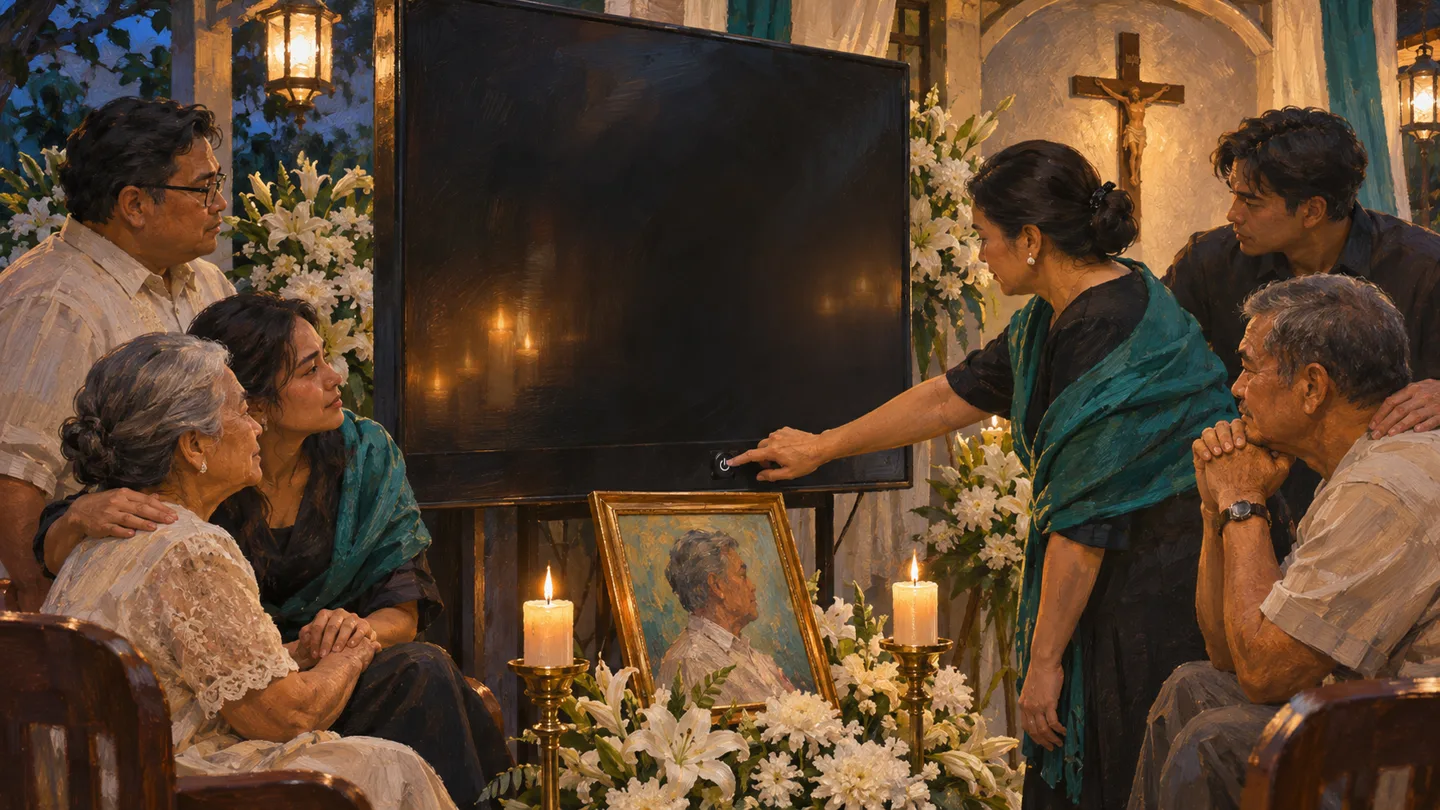
He asked readers to picture a wake. After the eulogies, the person who died appears on a screen and speaks in a familiar voice.
Philstar says he described funeral services in the United States that reportedly build a talking likeness from diaries, photos, videos, and a cloned voice.
Philstar presents that account as the cardinal's report. It does not say Philstar checked those services.
Before you upload a memory
A parish page, a group chat, or a wake may invite a photo or a voice of someone who has died.
The statement does not ban that sharing. Cardinal David's question, as Philstar reports it, is whether a talking copy helps grief or delays letting go.
Do not upload a private diary, a voice recording, or a set of family photos to an app you do not know.

Why it matters in the Philippines
The statement's chairman is a bishop in Laguna.
Parishes here already teach, pray, and message online.
Undas fell on 1 and 2 November 2026, the same weekend as Philstar's report.
Families share photos and voice notes of people they miss. A copied voice can feel close, or it can mislead.
The statement names deepfakes and cyber scams. Those show up in chats and on public pages.
A bishops' conference may later write its own safeguard. The statement does not say when.
What to do next
- Read the request as guidance for bishops' conferences. It is not a parish ban that starts today.
- If a ministry uses AI to draft a prayer or a caption, a person should still check the words.
- Keep private diaries, voice notes, and family photos out of apps that offer a talking copy of the dead.
- If a voice or video asks for money, call the person on a number you already saved.
- Watch for a later text from the Catholic Bishops' Conference of the Philippines. The statement dates none.
How this was checked
On 3 November 2026 the four-page statement and the CBCP News article of 31 October 2026 were opened.
The meeting dates, the 30 October signature, the proposals, and the named harms are from the statement.
Philstar's 2 November 2026 report was opened the same day for Cardinal David's comments.
The Facebook post was not opened. His sentences stay in Philstar's wording.

Put this into practice
A copied voice and a Church statement can both be misread. These guides help you check a source, protect private files, and pause before you trust a clip.
Sources & further reading
- Final Statement of the FABC-OSC Bishops Meet 2026, signed 30 October 2026, opened 3 November 2026
- CBCP News, Asian bishops' communications arm urges AI safeguards, 31 October 2026, opened 3 November 2026
- Philstar, Cardinal slams AI use to bring back the dead, Evelyn Macairan, 2 November 2026, opened 3 November 2026
Source note. The linked sources support the news in this article. The explanations and suggested next steps are from Pinoy AI Works.