
What happened
On 18 February 2026, the Supreme Court En Banc, meaning the full Court, adopted its Governance Framework on the Use of Human-Centered Augmented Intelligence in the Judiciary. The resolution is A.M. No. 25-11-28-SC. Its full text is now on the Supreme Court E-Library.
The Court announced the framework on 19 March. It rests on three principles: fairness, accountability, and transparency. It covers justices and judges, court officials and employees, court users, and vendors who build AI tools for the Judiciary. Court users include members of the public and lawyers who file cases.
The framework also creates a Committee on Human-Centered Augmented Intelligence, called the AI Committee. It advises the full Court and can recommend rules for specific kinds of AI, such as generative AI and predictive AI.
Humans decide, AI only assists
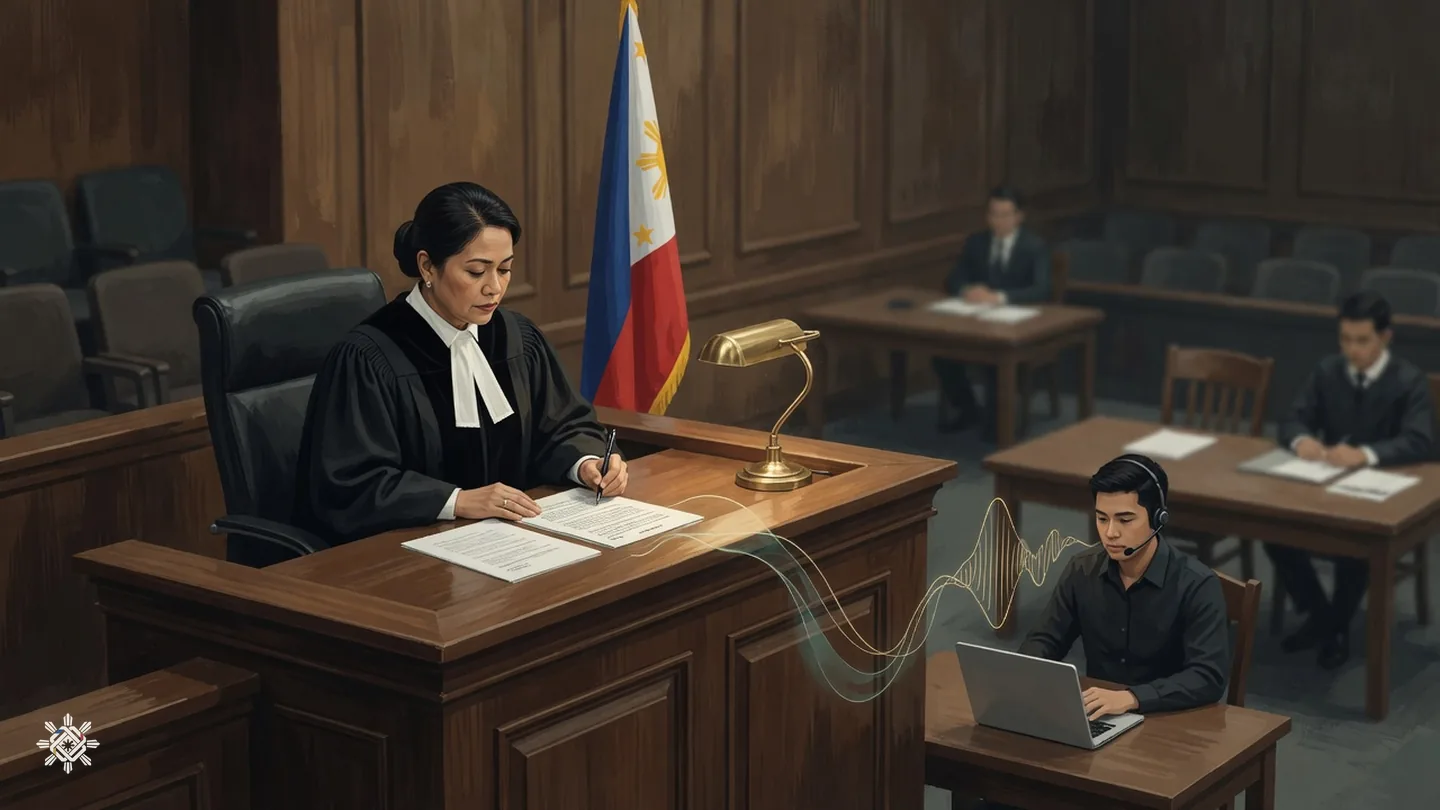
The framework says human control must be paramount in any use of AI. It says AI tools or their output must never be the sole, primary, or determinative basis of a court decision.
The legal reasoning and final conclusions that decide the rights and duties of parties must be formed by the human decision-maker. Whoever uses an AI tool, whether a judge, a court employee, or a court user, is personally responsible for what it produces.
When judges and court staff use AI in preparing court-issued documents, they must disclose it in plain language. The disclosure names the tool and its version, why it was used, how much it was relied on, and how much human oversight there was.
Scriptix is the approved exception
The framework says no AI tool may be used in the Judiciary unless the Supreme Court En Banc authorizes it.
In a release dated 10 July, the Supreme Court said that for now, only Scriptix, a voice-to-text transcription app, is allowed. Other AI apps need En Banc approval. The release described a briefing in Baguio City on 1 July, where Leonen said a machine may assist in research, scheduling, drafting, and analytics, but it may never adjudicate.
Scriptix is used by court stenographers. It turns spoken words into text, and a human remains responsible for the official record.
The current word on generative AI
Generative AI means tools like chatbots that write new text or images from a prompt. The framework itself does not name a ban. It leaves rules on generative AI to the AI Committee and the full Court.
On 23 September, speaking at Microsoft’s Frontier Transformation Day, Leonen said that for now, no generative AI may be used in the courts. That is according to Philstar Tech’s report. He said papers produced by or filed with the courts should not be made with generative AI unless the court permits it on the AI Committee’s recommendation.
He also said the AI Committee is reviewing applications and the possibility of a pilot program. The Philippine Judicial Academy is preparing training for judges, lawyers, and law students.
Why it matters in the Philippines
If you have a case, the key point is simple: a judge, not a chatbot, decides your rights. AI can help with work like transcription, but it does not decide the case.
If you are preparing something to file in court, do not assume a general-purpose chatbot is allowed just because it is free and easy to use online. The current statement is that court papers should not be made with generative AI unless the court permits it.
This is Pinoy AI Works reporting, not legal advice. For your own case, ask your lawyer, or the court handling it.
What to do before using AI for court-related work
- Check whether the exact tool and use are allowed under current Supreme Court rules.
- Keep a human responsible for the facts, citations, legal reasoning, and final document.
- Do not put confidential case details into an AI service the court has not approved.
- Watch for new Supreme Court issuances. The framework is designed to change as the AI Committee makes recommendations.
How this was checked
The date, scope, human-control rule, disclosure rule, En Banc authorization rule, and AI Committee role were read in the full resolution on the Supreme Court E-Library on 26 September 2026. The Supreme Court releases of 19 March and 10 July were opened the same day. The generative AI statement made on 23 September comes from Philstar Tech’s report, not from the resolution text. An older Supreme Court page listing 16 February was not used as the adoption date.

Put this into practice
New to AI, or want to check a story like this yourself? Start with these two guides.

Sources & further reading
- Supreme Court E-Library, A.M. No. 25-11-28-SC full text, dated 18 February 2026
- Supreme Court, “SC Adopts Framework for Judiciary’s Use of Artificial Intelligence,” 19 March 2026
- Supreme Court, “Senior Associate Justice Leonen Stresses AI’s Role Is to Assist, Not Adjudicate,” 10 July 2026
- Philstar Tech, “PH courts’ AI framework highlights human oversight,” 23 September 2026
Source note. The linked sources support the news in this article. The explanations and suggested next steps are from Pinoy AI Works.