
What DOST is actually building
Start with the primary document. DOST-PCIEERD’s 2026 Call for Proposals includes a program called “Beyond Words: Advancing Large Language Models.” The call asks for Philippine-language corpora and models, not only tools that answer in English.
The same call covers languages targeted by the Komisyon sa Wikang Filipino, plus underrepresented and endangered languages. It also asks for cross-lingual and multilingual capability, so a system can work across languages instead of treating each one as a separate silo.
Specialized applications are part of the call. The listed domains include education, healthcare, government services, business and industry, and creative industries. A program proposal can contain two or three component projects. The maximum allocation stated in the call is 30 million pesos per program proposal.
That document is a research-funding call. It shows where DOST is directing research money. It does not, by itself, mean a finished national model is already in public use.
Why NAICRI matters
DOST-ASTI’s National Artificial Intelligence Center for Research and Innovation, or NAICRI, is the capacity piece. Its public page says the Philippines has limited capacity to develop and operate sovereign frontier-scale AI models, and that NAICRI exists to help build national research, compute, and model capacity.
Compute is the machinery needed to train and run large models. Language data does not become a working model without researchers, computers, and a place to do the work. NAICRI is that national effort.
NAICRI has not launched a Philippine large language model. A center that can host future model work is not the same as a finished model you can open today.
What already exists
DOST-ASTI already has language technology you can look up. iTANONG is a natural-language interface to databases. The DOST-ASTI project page, checked on 27 September 2026, says people can type questions in Filipino, English, or Taglish.
That page, and the NAICRI launch page, are the live DOST-ASTI descriptions. They show Philippine-language work that started before this September’s budget hearing. They are a foundation. They are not the newly approved national model.
These are building blocks and related systems, not proof that the new national multilingual LLM is already publicly available.
What the budget hearing added
A separate claim comes from September 2026 news reports on the DOST budget hearing, not from a DOST project page found in this check. The Philippine Daily Inquirer reported that DOST is developing its own large language model for the Philippines’ major languages, including languages used by smaller communities.
The Inquirer report says Secretary Renato Solidum Jr. described the project as already approved, and said it would be accessible to the public by 2027. Rappler’s 23 September report likewise says DOST is developing an AI model trained on local languages and that it is expected to be available by 2027.
On 27 September 2026, a fresh search of DOST, DOST-ASTI, and DOST-PCIEERD pages did not find an official page that names this newly approved program or that confirms the 2027 date. Until DOST publishes that plan, treat 2027 as a reported target. It is not a guaranteed launch date.
Why this matters in the Philippines
Global models usually have far more training text for languages such as English. Philippine languages have less of that public data, so answers can miss local context even when the grammar looks fine. Local research is an attempt to close that gap. A model made here is not automatically more accurate, safer, or more neutral.
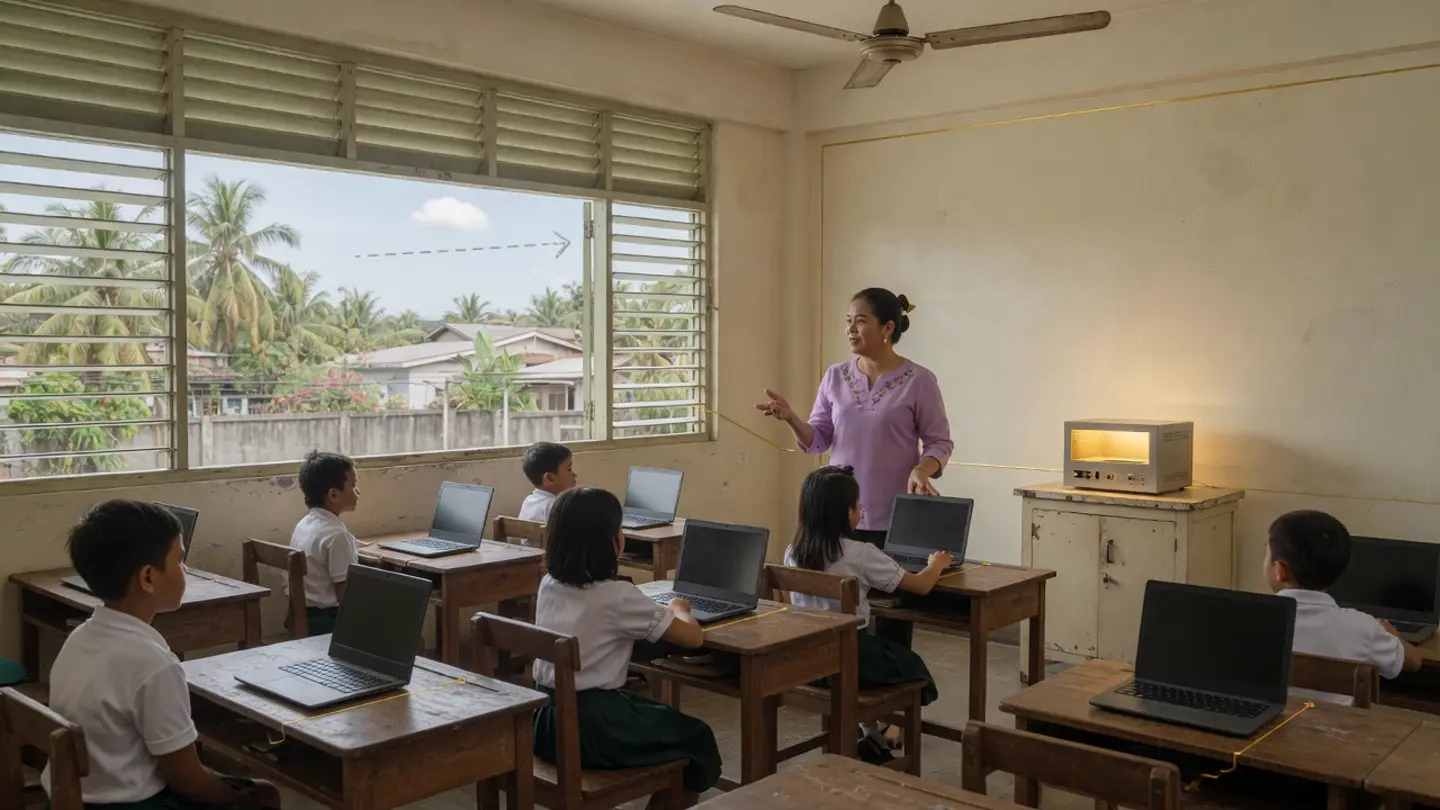
If the work succeeds, the useful places are ordinary. Students and teachers could get explanations in Filipino or another Philippine language. A government office could search its own manuals without forcing every question into English. Health information, research notes, and local-language interfaces are the kinds of uses the PCIEERD call names.
Support for languages that global products rarely cover would matter just as much. Those are intended directions. They are not finished products you can assume are ready.
What is available now
No public consumer national Philippine multilingual LLM was verified as available as of the final source check. You cannot download it, call a public interface for it, or open it the way you open a commercial chatbot.
iTANONG and the other live DOST-ASTI pages are real. They are not a substitute for that national model, and they do not mean the newly approved program is already open to the public.
Ownership, licensing, model design, hosting, and the public-access method are still open. This check did not find a primary source that settles whether a future model will be openly licensed, downloadable, offered through an interface, limited to government, or hosted for the public.
What to watch next
- The official program name and the funded implementers.
- Which languages are selected, including smaller or endangered ones, and which datasets support them.
- The architecture and the evaluation benchmarks used to judge quality.
- Privacy and data-governance rules, plus licensing.
- API availability, downloadable weights, and any public beta.
- Whether access is government-only or public, and any official 2027 release plan.
What you can do
- If a product later says it is the official Philippine AI model, check the claim on a DOST or DOST-ASTI page before you rely on it.
- Researchers and developers can watch PCIEERD calls and DOST-ASTI releases for datasets and models.
- Schools and agencies should still fact-check local-language answers. A Filipino sentence can be fluent and wrong.
- Watch whether a future model is downloadable, offered as an interface, limited to government, or hosted for the public.
- Treat 2027 as a target until DOST publishes an actual release plan.
How this was checked
On 27 September 2026, Pinoy AI Works reopened the DOST-PCIEERD 2026 Call for Proposals PDF, the DOST-ASTI NAICRI launch page, and the DOST-ASTI iTANONG project page. The 30 million peso cap, the two-or-three component projects, the language scope, and the iTANONG wording above come from those pages.
The approved-program description and the 2027 public-access line come from the Inquirer and Rappler reports on the September budget hearing. They are labeled as reporting because no newer DOST, DOST-ASTI, or DOST-PCIEERD page found in this check states them.

Put this into practice
New to AI, or want to check a story like this yourself? Start with these two guides.

Sources & further reading
- DOST-PCIEERD 2026 Call for Proposals (PDF), Beyond Words: Advancing Large Language Models
- DOST-ASTI, Launch of the National Artificial Intelligence Center for Research and Innovation (NAICRI)
- DOST-ASTI iTANONG project page, checked 27 September 2026
- Inquirer, 23 September 2026, DOST building its own large language model
- Rappler, 23 September 2026, DOST developing an AI model for local languages
Source note. The linked sources support the news in this article. The explanations and suggested next steps are from Pinoy AI Works.