
Quick take
The fresh report is local. On 3 October 2026, PIA said DOST Cagayan Valley, DepEd Region 2, and the Schools Division Office of Santiago City launched and turned over e-TURO at Santiago West Central School. The turnover date in that story is 24 September, not the publication date of this article.
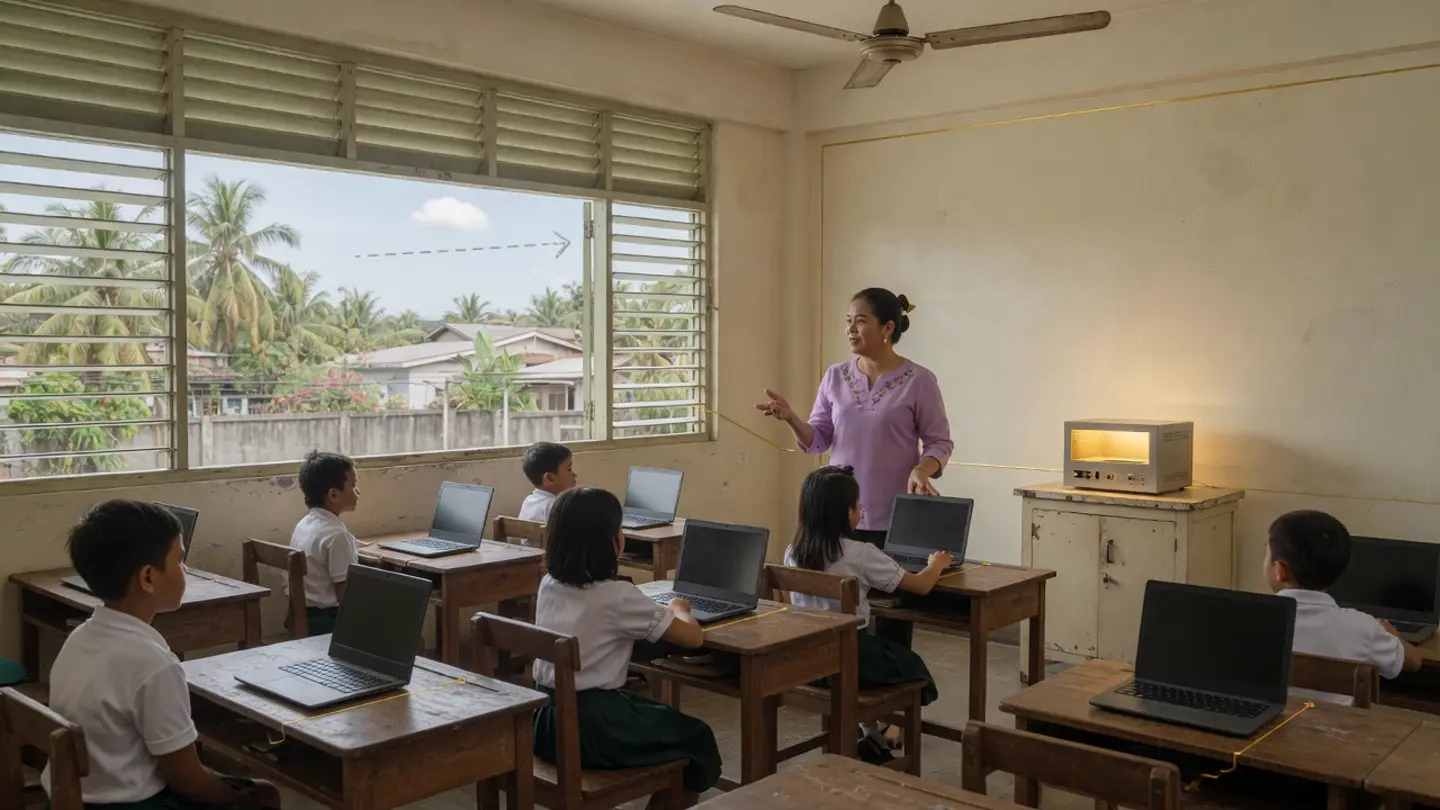
PIA describes that system as a learning management system, a digital content library, and AI-assisted content-creation tools. Teachers can use them for lesson preparation, classroom activities, and learner assessment. The same story says the system is designed to complement teachers' classroom strategies rather than replace the role of educators.
Zoom out and the Santiago turnover sits beside other regional reports about the same name. Ilocos Norte has a deployment. MIMAROPA has a pilot whose implementation PIA says has begun. Tabuk City has a pilot and a later equipment turnover. Eastern Visayas has a signed pilot memorandum. None of those pages says every Philippine public school has e-TURO.
What e-TURO actually does
Treat e-TURO as a school system, not as a chat box for students. The Santiago report combines a learning management system, a digital content library, and AI-assisted tools for making instructional content. It also names lesson preparation, classroom activities, and learner assessment.
In Ilocos Norte, PIA calls it an AI-powered learning management system with offline capabilities. Schools can use digital educational content through local servers when internet access is unavailable. PIA says it was designed by RYR Solutions, a DOST science and technology partner, and that it combines a digital content library with local connectivity equipment.
DOST Science Research Specialist II Justin Madrid drew a line that this article keeps. "When we say AI, it doesn't mean that all of its content is AI-generated. What our AI does is take the MATATAG curriculum and use it to generate structured content within the system."
The MIMAROPA report uses a related list: an offline-capable learning management system, curriculum-aligned multimedia, AI-powered content creation, and automated assessment tools. The Tabuk report from 24 August 2026 says the system uses AI to generate learning contents and assessments, and that the learning management system is aligned with the DepEd basic education curriculum. That Tabuk report names the developer as RYR Innovations. The Ilocos report names RYR Solutions. This article does not collapse those two names into one.
DOST Regional Director Virginia G. Bilgera, quoted by PIA in Santiago City, said the platform gives schools additional digital learning resources "subject to the available infrastructure and local deployment." That sentence does not say Santiago West Central School received a local server.
Why offline-first matters
This section is Pinoy AI Works analysis. It is not a claim by DOST or DepEd.
Many AI education products assume a cloud account, reliable broadband, and a connection that stays up for the whole lesson. A tool that only works in that setting skips the schools where the connection drops.
e-TURO is interesting where the reports put that constraint in the design. In Ilocos Norte, Dingras Mayor Joemelle Ernesti Saguid-Go Sy, on the DOST Ilocos Region page, called the offline-first feature a practical answer to limited connectivity. PIA Ilocos says students and teachers in connectivity-challenged schools can reach digital resources even without a steady internet connection. PIA MIMAROPA calls the learning management system offline-capable. GuruPress Cordillera says each of two Tabuk schools received a local server, and that the system is meant for places where internet may be limited or unreliable.
The Santiago City report does not use those words. It describes teacher tools and digital resources, then leaves infrastructure to whatever was locally deployed. Offline-first is a documented feature of some e-TURO reports. It is not a sentence this article can paste onto every site.
Where it is being tested
The rows below use only pages opened for this story on 3 October 2026. Each status word is the source's own word. This is not a complete list of schools, and a project title that names several regions is not a census of classrooms.
- Ilocos Norte. San Nicolas Elementary School and Dingras West Central Elementary School. Partners: DOST Ilocos Region, the DepEd regional office, and the Schools Division Office of Ilocos Norte. DOST calls the 15 September 2026 handover a deployment and the project a pilot. The orientation page says 95 e-TURO units were split 47 to San Nicolas Elementary and 48 to Dingras West Central, with teacher orientations on 15 September 2026 and on 16 September 2026. PIA, dated 22 September 2026, describes 95 laptops plus smart televisions and local connectivity equipment, with the same 47 and 48 laptop split, and says the system can run digital content through local servers.
- Cagayan Valley. Santiago West Central School in Santiago City, Isabela. Partners: DOST Cagayan Valley, DepEd Region 2, and the Schools Division Office of Santiago City. PIA published on 3 October 2026 that the agencies launched and turned over e-TURO on 24 September. The report describes a learning management system, a digital content library, and AI-assisted content-creation tools for lesson preparation, classroom activities, and learner assessment. It says the system complements teachers. It does not describe a local server or an offline mode at this school.
- MIMAROPA. San Agustin Central Elementary School in Romblon, and Don Luis Hidalgo Memorial School in Boac, Marinduque. Partners: DOST-MIMAROPA and DepEd Romblon. PIA reported on 30 September 2026 that implementation has begun at San Agustin Central, which it calls a pilot beneficiary school. The project costs 2.123 million pesos and runs from 1 July 2026 to 30 June 2027. PIA calls the platform an offline-capable learning management system with curriculum-aligned multimedia, AI-powered content creation, and automated assessment tools, for Grade 6 learners.
- Cordillera, Kalinga. Bulanao Central School and Laya West Elementary School in Tabuk City. Partners named across the reports: DOST-CAR, the Schools Division Office of Tabuk City, and the Tabuk City government. PIA reported on 16 December 2025 that DOST-CAR had piloted the system for one year with Grade 4 learners at those two schools, after a memorandum on 4 December 2025. A PIA report on 24 August 2026 says DOST-CAR and DepEd are testing the system in two public schools in the city and does not rename the schools. GuruPress Cordillera reports a turnover on 28 September of a 2.7-million-peso package: 80 laptops pre-installed with Grade 2 learning contents, 68 for Bulanao Central and 12 for Laya West, plus a smart TV and a local server at each school and 12 months of internet connectivity. That page does not print a year on the 28 September sentence. The Grade 4 and Grade 2 details come from different reports and are not reconciled here.
- Eastern Visayas. Sto. Niño SPED Center in Tacloban City and Guinsorongan Elementary School in Catbalogan City. Partners: DOST Region VIII and DepEd Region VIII. The DOST page says the agencies signed a memorandum for the pilot implementation of e-TURO. It names those two schools. It does not state a budget, a signing date, or a grade level.

Teachers remain central
The Santiago report says a hands-on orientation followed the turnover, so teachers and school personnel could try the features. Principal Marilou L. Buizon welcomed tools for technology-enhanced instruction. Janet V. Bautista accepted the system for the Santiago City division. The story's design line is that the tools complement classroom strategies rather than replace educators.
In Ilocos Norte, DOST held orientations at San Nicolas Elementary School on 15 September 2026 and at Dingras West Central Elementary School on 16 September 2026. The sessions covered daily lesson plans, student engagement, and offline-first digital content. Justin Madrid and Alex Gallo of RYR Innovation facilitated them. PIA says a two-day training was also planned so teachers could use the system, and Schools Division Superintendent Donato Balderas Jr. said DepEd would work with DOST on implementation.
The MIMAROPA report says teachers will have capacity-building on AI-enabled instructional tools, with monitoring and evaluation. In Tabuk, the December 2025 PIA report says Superintendent Benedicta B. Gamatero hoped the system would ease teachers' workload. That is a hope in a quote, not a measured result. GuruPress quotes DOST-CAR Director Nancy A. Bantog telling teachers to integrate the system into instruction. The August 2026 PIA report says the Tabuk pilot is meant to support classroom instruction and to see how AI can be integrated into it.
Nothing in these pages describes an AI teacher, an unmanned class, or a student chatbot that assigns the lesson on its own.
What we don't know yet
These pages do not report measured learning outcomes across the current pilots. They do not report an independent evaluation. They do not show whether the tools raise or lower teacher workload after the orientations end.
DOST Ilocos Region Director Teresita A. Tabaog said the Ilocos work is a pilot and that sustaining it depends on execution and on students, educators, administrators, and partners. That is a warning about sustainability, not a result. This article has no later evidence that the pilots are being sustained.
Some project prices are public. MIMAROPA's reported cost is 2.123 million pesos for the stated period. GuruPress reports a 2.7-million-peso Tabuk package. Those figures are not a cost per school at scale, and no page opened today states a decision to put the system in every public school.
A PIA story from 16 December 2025 quotes DOST-Kalinga on a DOST Region V-led project whose title lists Regions I, II, CAR, V, VIII, and XII. This article verified named schools only in the rows above. It did not find, in the pages it opened, a school-level deployment report for Region V or for Region XII. San Agustin Mayor Aaron James Madrona's office told PIA the town plans to add four more elementary schools next year. That is a stated plan, with a reported 5 million pesos per school from the Local Government Support Fund. It is not a completed deployment.
The Philippine News Agency sites for the Ilocos Norte and Eastern Visayas stories were in maintenance when opened on 3 October 2026. Figures that this desk had previously seen only on those pages are left out until those pages can be read again.
PH context
e-TURO is a basic-education pilot story. It is not a new national AI policy. DepEd Order No. 003 remains the published basic-education guideline on AI in schools, and it still expects a human to stay in charge of teaching decisions.
A separate article from 2 October 2026 on this site covers an Instructure survey of higher-education and tech-voc practitioners in three metropolitan areas. That sample is about college and technical-vocational readiness. It is not evidence about these e-TURO elementary schools.
Hiraia, covered earlier here, is a different offline science tutor. It is not e-TURO, and a school that has heard of one does not automatically have the other.
Everyday Filipino angle
If you are a parent or a teacher, this does not mean your public school now has an AI system. The named sites are specific campuses in Ilocos Norte, Santiago City, Romblon, Marinduque, Tabuk City, Tacloban City, and Catbalogan City. A school that is not on that list was not shown, in these sources, to have received e-TURO.
The useful question is narrower. Where a connection is unreliable, can a school still reach curriculum materials and give teachers preparation help from equipment that sits in the school? Ilocos Norte, MIMAROPA, and the Tabuk turnover reports are the pages that speak to that question. The Santiago report speaks to teacher tools and a real turnover, and it leaves the infrastructure question open.
Ask the school, or read the linked government page, before you tell a child that their class already uses it.
Put this into practice
A government launch is still a claim you can check. These two guides show how to read the original page, and how to try a simple AI tool yourself.

Sources & further reading
- PIA Cagayan Valley, 3 October 2026, Santiago City launch and turnover
- PIA Ilocos, 22 September 2026, offline access in Ilocos Norte
- DOST Ilocos Region, deployment of 95 e-TURO units, 15 September 2026
- DOST Ilocos Region, teacher orientations, 15 and 16 September 2026
- PIA MIMAROPA, 30 September 2026, San Agustin implementation
- PIA, 16 December 2025, Tabuk City pilot schools
- PIA, 24 August 2026, DOST-CAR and DepEd test in Tabuk
- GuruPress Cordillera, turnover report for two Tabuk schools
- DOST Eastern Visayas, partnership for the e-TURO pilot
- DepEd Order No. 003, basic-education AI guidelines
- Instructure survey of college and tech-voc practitioners, 2 October 2026
- Hiraia, a separate offline science tutor
Source note. The linked sources support the news in this article. The explanations and suggested next steps are from Pinoy AI Works.